Preserving our planet's precious water resources and ensuring supplies of clean water
We develop and produce innovative ultrafiltration technology used in the treatment of drinking water, process water, wastewater, and seawater. Our customers are system integrators which incorporate our ultrafiltration modules and/or pre-assembled rack systems within the overall process flow of their water treatment plants. We are a global company that provides consulting services, high-quality products, and specialist support to customers worldwide.
Take advantage of our years of experience and industry expertise, and allow our team of ultrafiltration experts to assist you in planning your treatment facility and finding solutions to meet your needs.
Streamlined DuPont™ Inge™ Brand TR Rack Solutions
| DuPont™ Inge™ Ultrafiltration Modules | Active Membrane Area (m²) | Capillary Diameter (mm) | Dimensions (mm) | Product Data Sheet | |
|---|---|---|---|---|---|
| Length incl. T-Piece |
Diameter | ||||
| Inge™ MB PRO XL 95 TR module | 95 | 0.7 | 2,101 | 250 |

|
| Inge™ MB PRO XL 82 TRS module | 82 | 0.7 | 1,879 | 250 |
|
| Inge™ MB 0.9 XL 80 TR module | 80 | 0.9 | 2,101 | 250 |
|
| Inge™ MB 0.9 XL 60 TRS module | 60 | 0.9 | 1,879 | 250 |
|
| Inge™ MB 1.5 XL 50 TR module | 50 | 1.5 | 2,101 | 250 |
|
| Inge™ MB 1.5 XL 40 TRS module | 40 | 1.5 | 1,879 | 250 |
|
Open Platform Inge™ Modules
| DuPont™ Inge™ Modules | Active Membrane Area (m²) | Capillary Diameter (mm) | Dimensions (mm) | Product Data Sheet | |
|---|---|---|---|---|---|
| Length | Diameter | ||||
| Inge™ MB PRO XL 95 OP module | 95 | 0.7 | 1,914 | 250 |
|
| Inge™ MB PRO XL 82 OP module | 82 | 0.7 | 1,679 | 250 |
|
| Inge™ MB 0.9 XL 80 OP module | 80 | 0.9 | 1,914 | 250 |
|
| Inge™ MB 0.9 XL 60 OP module | 60 | 0.9 | 1,679 | 250 |
|
| Inge™ MB 1.5 XL 40 OP module | 40 | 1.5 | 1,679 | 250 |
|
| Inge™ MB 0.9 XL 38 OP module | 38 | 0.9 | 1,179 | 250 |
|
| Inge™ MB 1.5 XL 25 OP module | 25 | 1.5 | 1,179 | 250 |
|
For further details, please refer to:
Retrofit and Upgrade Inge™ Modules
| DuPont™ Inge™ Modules | Active Membrane Area (m²) | Capillary Diameter (mm) | Dimensions (mm) | Product Data Sheet | |
|---|---|---|---|---|---|
| Length | Diameter | ||||
| Inge™ MB PRO L 64 H module | 64 | 0.7 | 1,537,5 | 220 |
|
| Inge™ MB 0.9 L 55 H module | 55 | 0.9 | 1,537,5 | 220 |
|
| Inge™ MB 0.9 L 40 HB module | 40 | 0.9 | 1,537,5 | 200 |
|
| Inge™ MB PRO L 64 V module* | 65 | 0.7 | 1,898 | 220 |
|
| Inge™ MB 0.9 L 55 V module* | 40 | 0.9 | 1,898 | 200 |
|
Submerged Inge™ Modules
| DuPont™ Inge™ Modules | Active Membrane Area (m²) | Capillary Diameter (mm) | Dimensions (mm) | Product Data Sheet | |
|---|---|---|---|---|---|
| Length | Diameter | ||||
| Inge™ MB PRO L 72 S module | 72 | 0.7 | 1,720 | 220 |
|
| Inge™ MB PRO L 64 S module | 64 | 0.7 | 1,898 | 220 |
|
| Inge™ MB 0.9 L 55 S module | 55 | 0.9 | 1,898 | 220 |
|
Inge™ TR Rack Modules with Integrated Pre-Filter
| DuPont™ Inge™ Modules | Active Membrane Area (m²) | Capillary Diameter (mm) | Dimensions (mm) | Product Data Sheet | |
|---|---|---|---|---|---|
| Length | Diameter | ||||
| Inge™ MB PRO XL 95i TR module | 95 | 0.7 | 2,101 | 250 |
|
| Inge™ MB PRO XL 82i TRS module | 82 | 0.7 | 1,879 | 250 |
|
| Inge™ MB 0.9 XL 80i TR module | 80 | 0.9 | 2,101 | 250 |
|
| Inge™ MB 0.9 XL 60i TRS module | 60 | 0.9 | 1,879 | 250 |
|
For further details, please refer to:
Inge™ Ultrafiltration Modules
The range of products incudes highly-efficient ultrafiltration modules and cost-effective, space-saving rack designs as the core component of water treatment plants, rounded off with outstanding technical support for our customers.
We have set ourselves the goal of preserving our planet's precious water resources and ensuring supplies of clean water in the future through the development of innovative new concepts. Our systems purify water by reliably removing bacteria, viruses, particles and suspended solids.
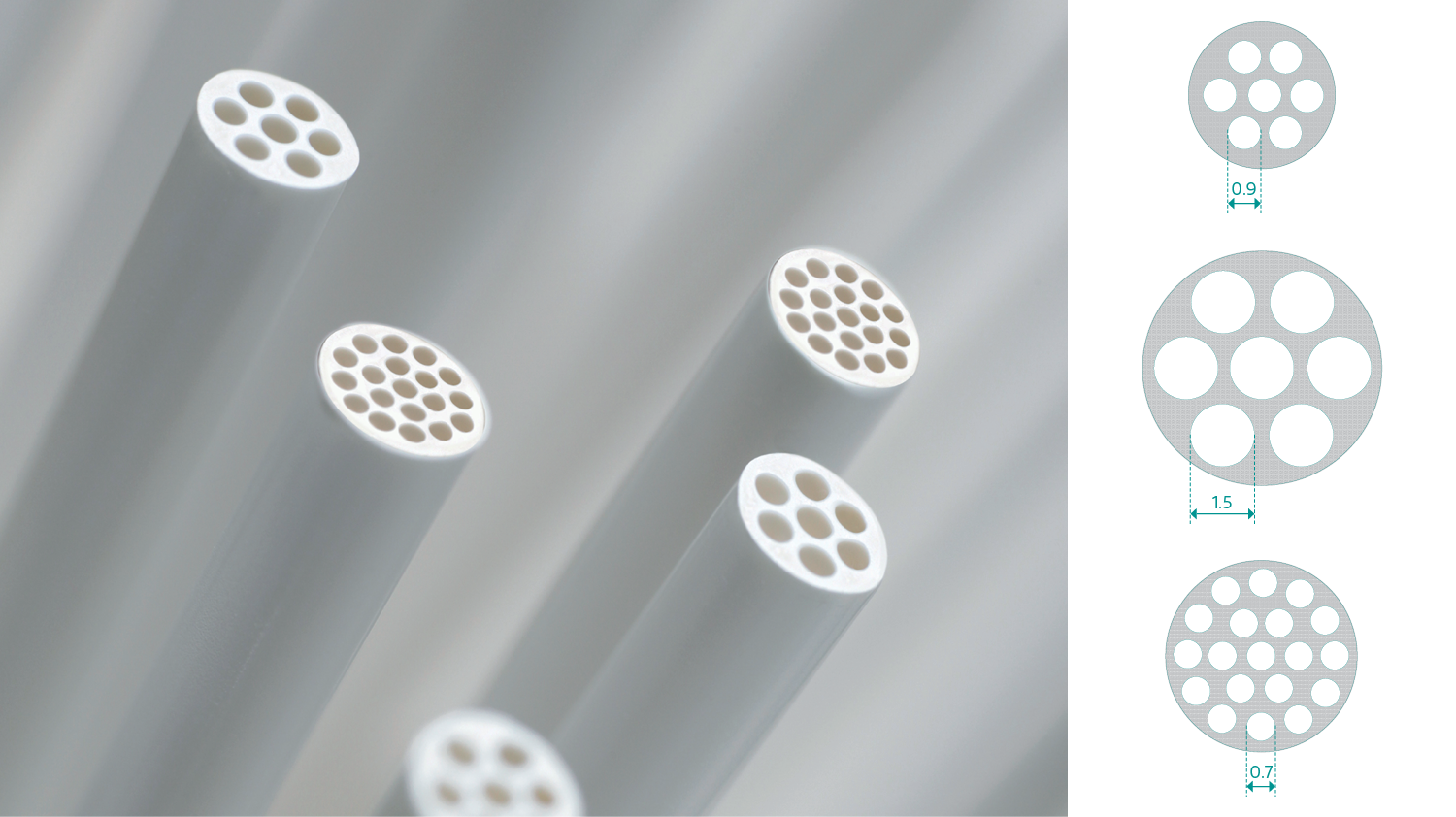
Features robust individual capillaries for excellent mechanical stability and long service life with minimal maintenance. It offers outstanding cleanability and low energy costs, helping maintain high filtrate quality regardless of raw water contamination levels.
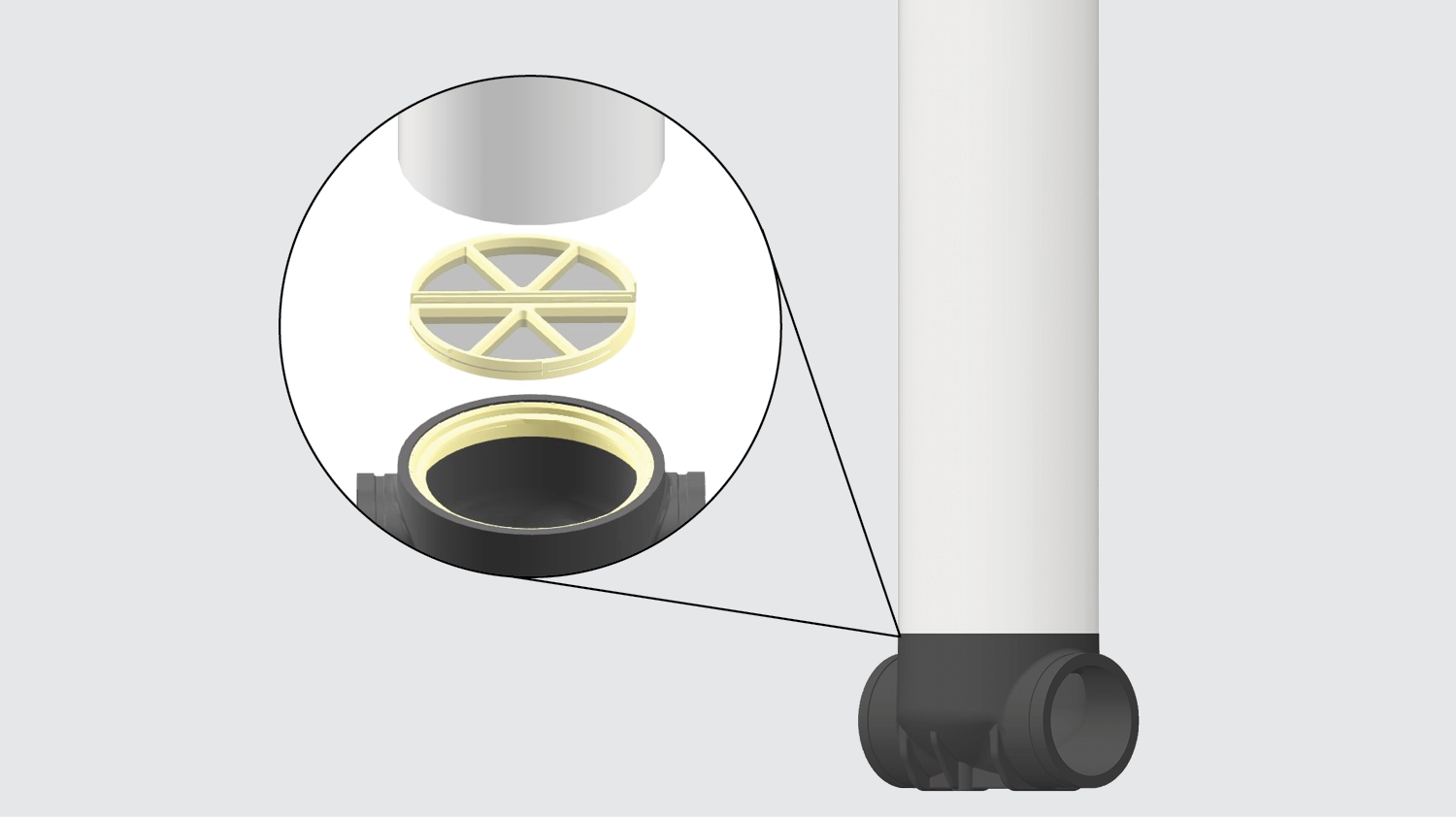
Inge™ ultrafiltration modules now feature an integrated pre-filter, eliminating the need for an external pre-filtration step and offering benefits such as reduced footprint and capital costs.
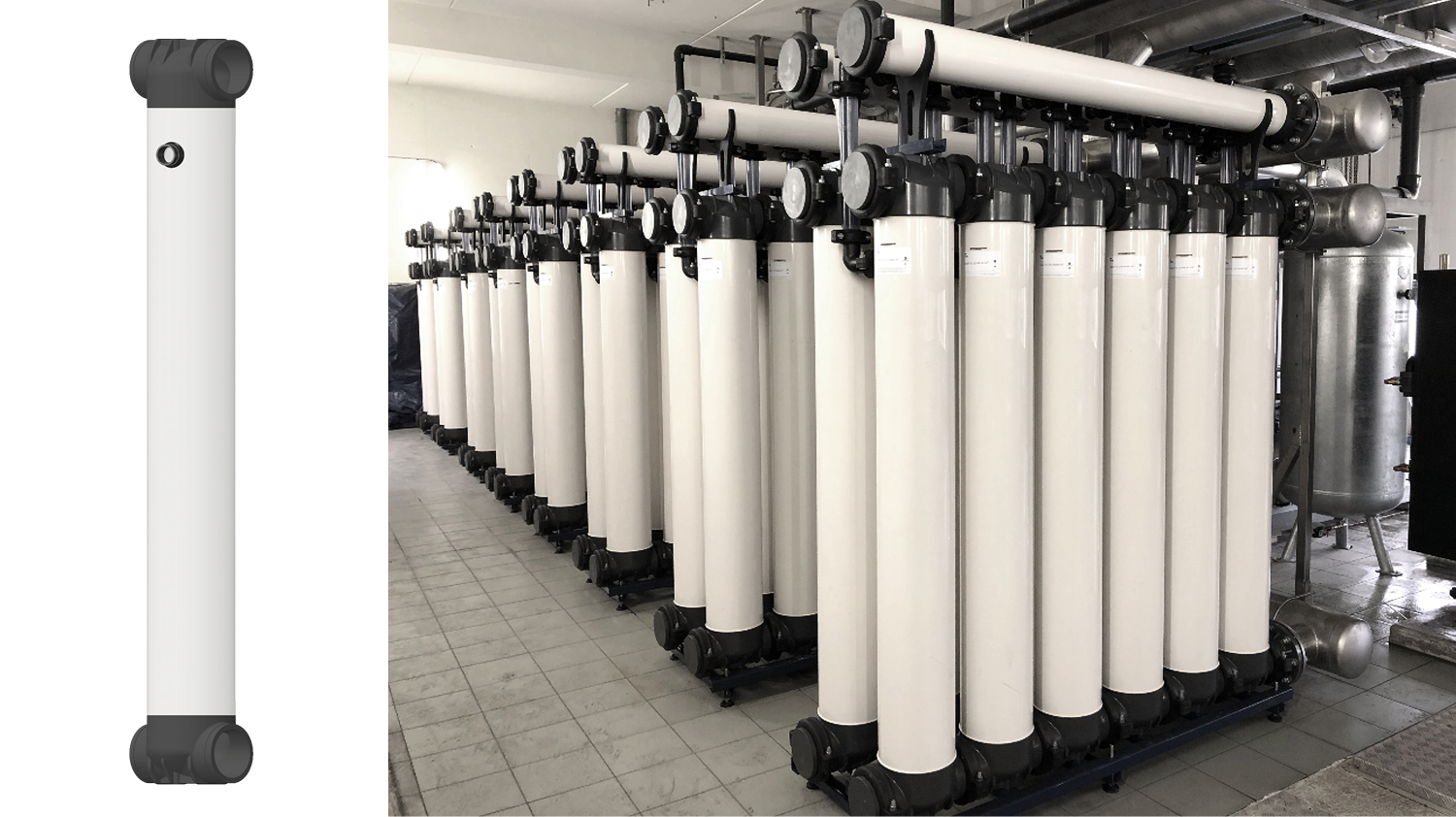
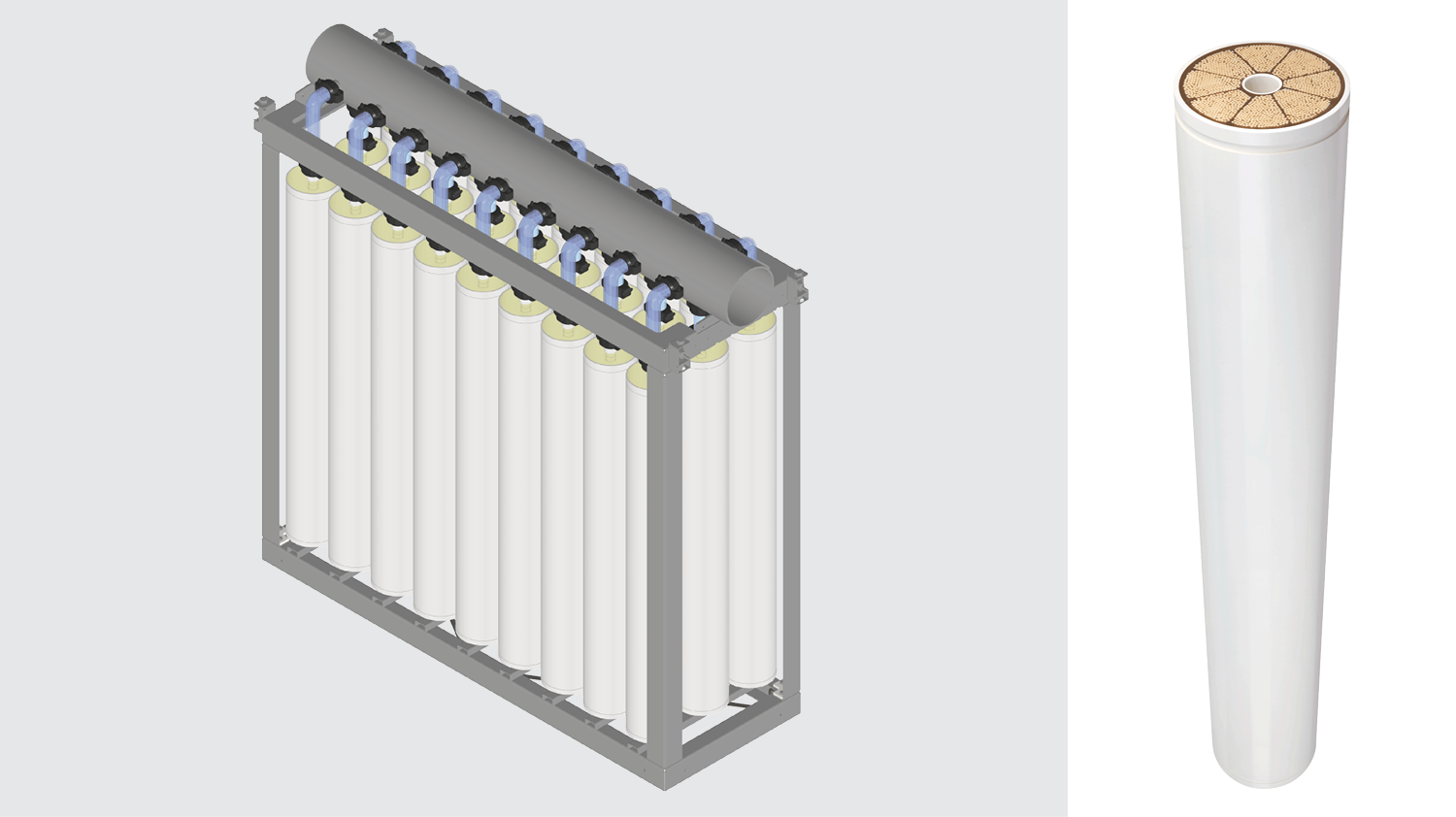
Hydrodynamically optimized rack solution that maximizes space use with Inge™ MB XL TR modules. The modular design, consisting of subunits with 4 to 68 modules arranged in 2 to 4 module rows, allows for scalable plant configurations
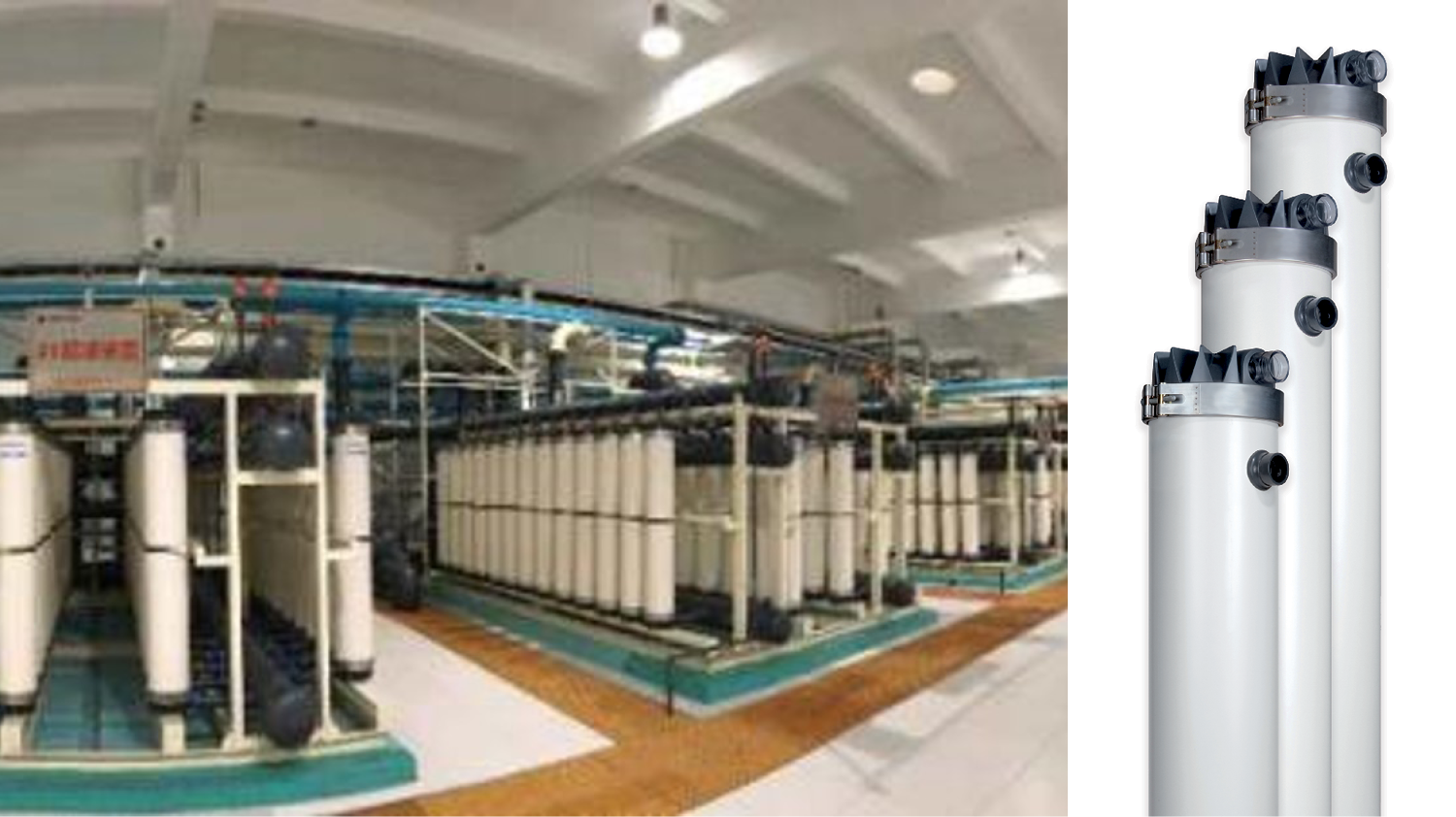
Inge™ MB XL OP ultrafiltration modules for individual rack solutions in open platform configuration
High-performance ultrafiltration modules for submerged rack configurations, with 3 to 9 modules per row. The flexible design integrates easily into existing systems, making it ideal for large units with minimal automatic components.
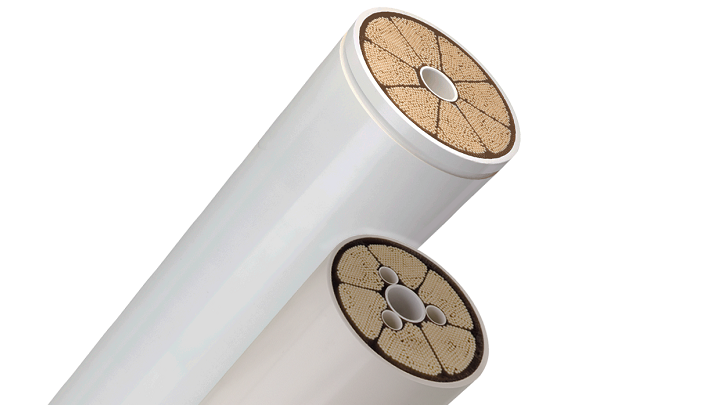
Inge™ cartridge type ultrafiltration modules designed for streamlined replacement of existing membrane filtration elements.


Covering many applications
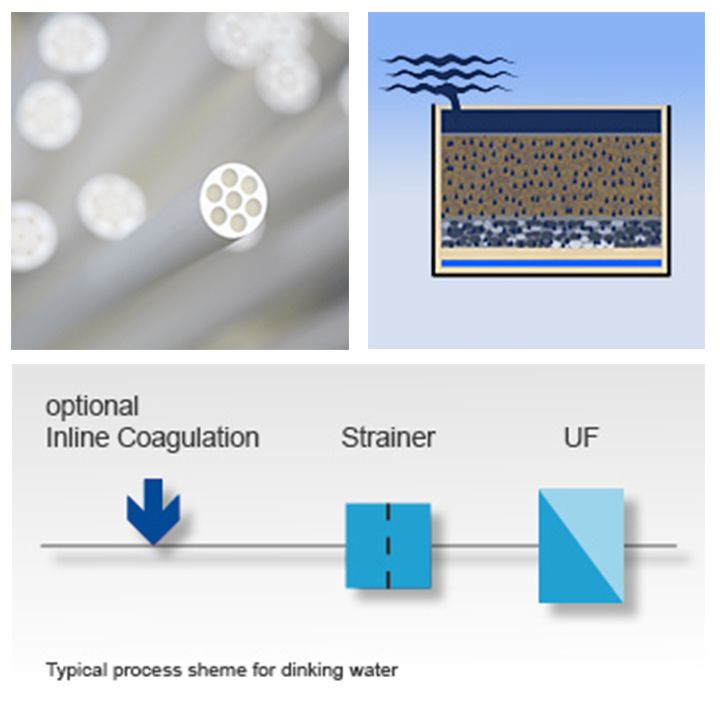
Ultrafiltration is the perfect method for producing drinking water from surface water, groundwater and spring water.
In the past, sand filtration was the standard method of water treatment. Similar to the natural water cycle, in which water flows through layers of rock and sand, this technique involved trickling the water through beds of sand in order to clean it.
Ultrafiltration is superior to sand filtration thanks to its consistently high levels of quality and purity
Nowadays, drinking water is produced using ultrafiltration technology with nanoscale membranes. Thanks to their extremely small pore size, Inge™ MB fibers reliably intercept not only particles but also microorganisms, including bacteria and viruses, thereby providing a dependable source of clean water. This method is more reliable and requires considerably less space than sand filtration. It is simple to operate and can easily be incorporated in complex water treatment plants as either an upstream or downstream stage.
The biggest advantage of ultrafiltration is that the filtered water always maintains consistently high levels of quality and purity regardless of the level of contamination of the raw water. The same cannot be said of sand filtration: Heavy rainfall, floods or contaminants in the water supply can mean that the sand is no longer capable of retaining all the dirt particles. In contrast, ultrafiltration is not dependent on external factors – which means it can provide consistently high water quality.
Ease of operation is another major benefit. Ultrafiltration systems can be operated fully automatically with an integrated control unit running the entire ultrafiltration process including the filtration, cleaning and backwash stages.
Benefits of Inge™ ultrafiltration modules for drinking water treatment:
- Reliable removal of microorganisms and viruses
- Consistently high level of filtrate quality
- Maximum stability – zero fiber breakage
- Long service life and high availability
- High performance with low operating costs
Certification and Approval
The quality of the products and services provided by Inge™ modules has been fully certified. Our products have been granted full approval in the core markets of the USA, Europe, and China, and comply with all current regulations on drinking water treatment in the various regions. Comprehensive tests and procedures are undertaken by independent institutes to check that the membranes and modules produced by Inge™ brand achieve the stated filtration performance while posing no risk to people's health. The technologies supplied by Inge™ modules therefore provide maximum reliability combined with optimum, assured protection.
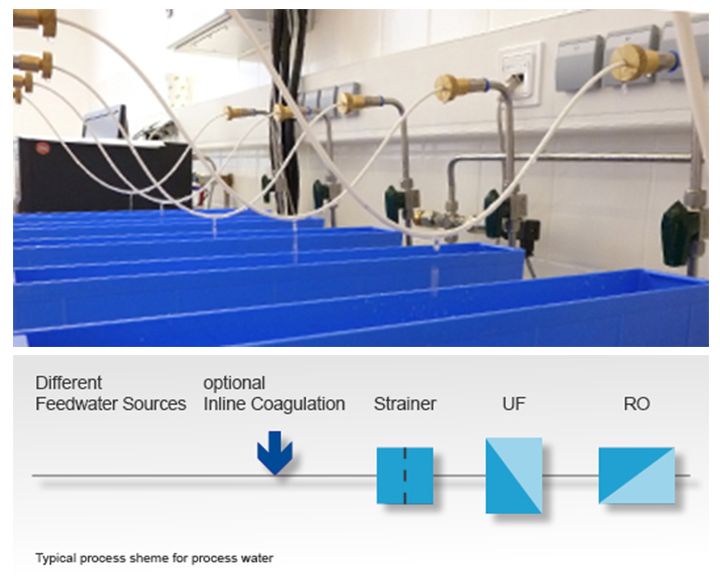
Water with specific properties: engineered water for industrial use
Water is not always as simple as it seems. It is often required to have – or specifically not to have – very specific properties, especially when it comes to industrial applications. The properties of water can be deliberately modified to meet the technological requirements of various industrial processes. For example, solids can be removed from the water using methods such as de-icing, softening and desalination, other agents can be added, or the water's parameters, such as its pH value, can be modified.
The fact is that some components of water can cause significant damage to systems and processes in industrial applications if the potential risks are not taken into account. For example, cooling water must be modified so that it is suitable for use in refrigeration units, while the water for steam turbines must be completely desalinated to prevent corrosion from damaging the boiler.
Ultrafiltration is not only used in water treatment, but also in many other industrial treatment and separating processes. UF is a highly effective substitute for sand filtration in these applications, producing outstanding water quality and consistently high filtrate quality regardless of variations in the quality of the raw water.
Benefits of Inge™ultrafiltration modules for process water treatment:
- The perfect pre-treatment technology upstream of reverse osmosis
- Consistently high level of filtrate quality
- Long service life and high availability
- Low maintenance costs
- Compact footprint of UF system
- High performance with low operating costs
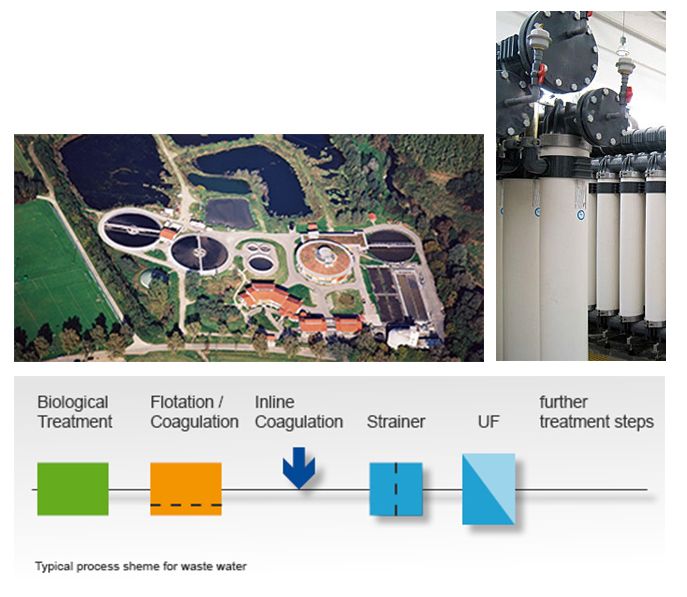
Wastewater is water that has become contaminated through use. It includes household sewage, municipal wastewater, industrial effluent, collected rainwater, and surface runoff, i.e., water that flows off paved surfaces. Wastewater treatment is generally carried out in three to four stages in centrally located sewage works. The cleaning stages typically include physical, biological, and chemical processes. To ensure that the water that leaves the sewage works is genuinely clean, however, a further stage is required to remove pathogenic germs and viruses. This is where ultrafiltration technology can be used to purify the wastewater without requiring any additional chemical treatment.
Ultrafiltration not only enables the removal of specific products from complex material streams, it also makes it possible to separate other useful by-products and "pure" water. Reuse concepts can then be applied to recycle these materials within the production process.
Benefits of Inge™ modules for wastewater treatment:
- Maximum stability – zero fiber breakage,
- Long service life and high availability
- Consistently high level of filtrate quality
- Membranes tolerate a wide pH range and are exceptionally easy to clean
- Reliable removal of microorganisms and viruses
- The perfect pre-treatment technology upstream of reverse osmosis
- Maximum removal of nutrients
- Can be combined with methods designed to eliminate trace contaminants
For decades, drinking water and water for domestic use have been obtained through traditional thermal methods of seawater desalination: The sea water is heated until it reaches boiling point and evaporates, at which point the hot steam is cooled and condensed into fresh water. However, this process has some major disadvantages, notably the fact that it uses such large amounts of energy. Despite the use of various energy recovery technologies, it is often not financially viable – especially in countries that lack energy resources.
Ultrafiltration and reverse osmosis
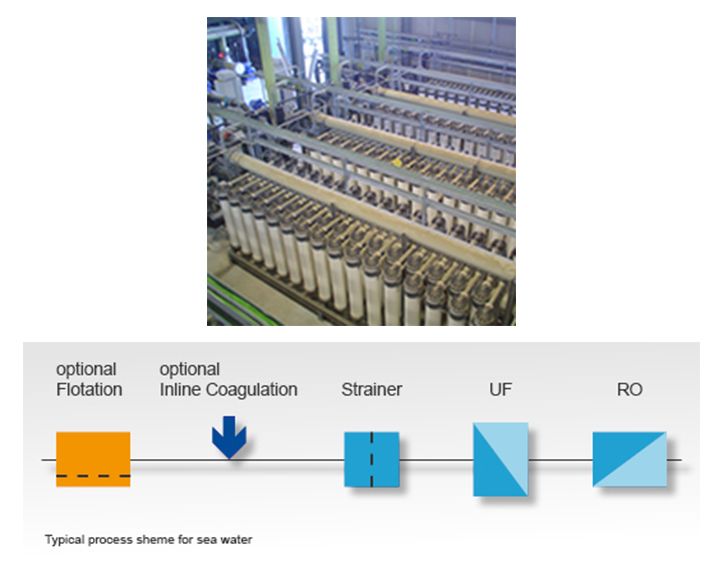
The best alternative for future applications is a combination of ultrafiltration and reverse osmosis. The initial cleaning of the seawater is performed efficiently by ultrafiltration, while the actual desalination of the water is achieved through reverse osmosis.
Compared to conventional treatment technologies such as sand filtration, UF technology produces outstanding water quality and consistently high filtrate quality, regardless of any changes in raw water properties due to seasonal variations (storms, algae bloom, etc.) or other factors.
Benefits of Inge™ ultrafiltration modules for seawater treatment:
- Maximum stability – zero fiber breakage – minimal risk of biofouling
- Consistently high level of filtrate quality
- Tolerance over a wide pH range – exceptionally easy to clean
-
Treating drinking water
Ultrafiltration is the perfect method for producing drinking water from surface water, groundwater and spring water.
In the past, sand filtration was the standard method of water treatment. Similar to the natural water cycle, in which water flows through layers of rock and sand, this technique involved trickling the water through beds of sand in order to clean it.
Ultrafiltration is superior to sand filtration thanks to its consistently high levels of quality and purity
Nowadays, drinking water is produced using ultrafiltration technology with nanoscale membranes. Thanks to their extremely small pore size, Inge™ MB fibers reliably intercept not only particles but also microorganisms, including bacteria and viruses, thereby providing a dependable source of clean water. This method is more reliable and requires considerably less space than sand filtration. It is simple to operate and can easily be incorporated in complex water treatment plants as either an upstream or downstream stage.
The biggest advantage of ultrafiltration is that the filtered water always maintains consistently high levels of quality and purity regardless of the level of contamination of the raw water. The same cannot be said of sand filtration: Heavy rainfall, floods or contaminants in the water supply can mean that the sand is no longer capable of retaining all the dirt particles. In contrast, ultrafiltration is not dependent on external factors – which means it can provide consistently high water quality.
Ease of operation is another major benefit. Ultrafiltration systems can be operated fully automatically with an integrated control unit running the entire ultrafiltration process including the filtration, cleaning and backwash stages.
Benefits of Inge™ ultrafiltration modules for drinking water treatment:
- Reliable removal of microorganisms and viruses
- Consistently high level of filtrate quality
- Maximum stability – zero fiber breakage
- Long service life and high availability
- High performance with low operating costs
Certification and Approval
The quality of the products and services provided by Inge™ modules has been fully certified. Our products have been granted full approval in the core markets of the USA, Europe, and China, and comply with all current regulations on drinking water treatment in the various regions. Comprehensive tests and procedures are undertaken by independent institutes to check that the membranes and modules produced by Inge™ brand achieve the stated filtration performance while posing no risk to people's health. The technologies supplied by Inge™ modules therefore provide maximum reliability combined with optimum, assured protection.
-
Producing process water
Water with specific properties: engineered water for industrial use
Water is not always as simple as it seems. It is often required to have – or specifically not to have – very specific properties, especially when it comes to industrial applications. The properties of water can be deliberately modified to meet the technological requirements of various industrial processes. For example, solids can be removed from the water using methods such as de-icing, softening and desalination, other agents can be added, or the water's parameters, such as its pH value, can be modified.
The fact is that some components of water can cause significant damage to systems and processes in industrial applications if the potential risks are not taken into account. For example, cooling water must be modified so that it is suitable for use in refrigeration units, while the water for steam turbines must be completely desalinated to prevent corrosion from damaging the boiler.
Ultrafiltration is not only used in water treatment, but also in many other industrial treatment and separating processes. UF is a highly effective substitute for sand filtration in these applications, producing outstanding water quality and consistently high filtrate quality regardless of variations in the quality of the raw water.
Benefits of Inge™ultrafiltration modules for process water treatment:
- The perfect pre-treatment technology upstream of reverse osmosis
- Consistently high level of filtrate quality
- Long service life and high availability
- Low maintenance costs
- Compact footprint of UF system
- High performance with low operating costs
-
Re-using wastewater
Wastewater is water that has become contaminated through use. It includes household sewage, municipal wastewater, industrial effluent, collected rainwater, and surface runoff, i.e., water that flows off paved surfaces. Wastewater treatment is generally carried out in three to four stages in centrally located sewage works. The cleaning stages typically include physical, biological, and chemical processes. To ensure that the water that leaves the sewage works is genuinely clean, however, a further stage is required to remove pathogenic germs and viruses. This is where ultrafiltration technology can be used to purify the wastewater without requiring any additional chemical treatment.
Ultrafiltration not only enables the removal of specific products from complex material streams, it also makes it possible to separate other useful by-products and "pure" water. Reuse concepts can then be applied to recycle these materials within the production process.
Benefits of Inge™ modules for wastewater treatment:
- Maximum stability – zero fiber breakage,
- Long service life and high availability
- Consistently high level of filtrate quality
- Membranes tolerate a wide pH range and are exceptionally easy to clean
- Reliable removal of microorganisms and viruses
- The perfect pre-treatment technology upstream of reverse osmosis
- Maximum removal of nutrients
- Can be combined with methods designed to eliminate trace contaminants
-
Treating seawater
For decades, drinking water and water for domestic use have been obtained through traditional thermal methods of seawater desalination: The sea water is heated until it reaches boiling point and evaporates, at which point the hot steam is cooled and condensed into fresh water. However, this process has some major disadvantages, notably the fact that it uses such large amounts of energy. Despite the use of various energy recovery technologies, it is often not financially viable – especially in countries that lack energy resources.
Ultrafiltration and reverse osmosis
The best alternative for future applications is a combination of ultrafiltration and reverse osmosis. The initial cleaning of the seawater is performed efficiently by ultrafiltration, while the actual desalination of the water is achieved through reverse osmosis.
Compared to conventional treatment technologies such as sand filtration, UF technology produces outstanding water quality and consistently high filtrate quality, regardless of any changes in raw water properties due to seasonal variations (storms, algae bloom, etc.) or other factors.
Benefits of Inge™ ultrafiltration modules for seawater treatment:
- Maximum stability – zero fiber breakage – minimal risk of biofouling
- Consistently high level of filtrate quality
- Tolerance over a wide pH range – exceptionally easy to clean
Related resources
See what’s possible
Ask how we can help your industry or market with our Inge™ modules portfolio of ultrafiltration membranes.